Queer Places:
4 Dorset Gardens, Kemptown, Brighton and Hove, Brighton BN2 1RL, UK
University of Cambridge, 4 Mill Ln, Cambridge CB2 1RZ
Ascension Parish Burial Ground, Cambridge, City of Cambridge, Cambridgeshire, England
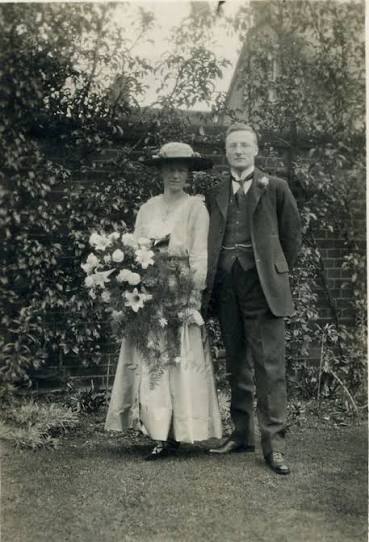 Margaret de Gaudrion Verrall (née Merrifield, December 21, 1857 - July 2, 1916) was born on December 21, 1857, at 4 Dorset Gardens, Brighton, as the eldest of two daughters
born to Frederick Merrifield and Maria Angélique de Gaudrion. She entered Newnham College, Cambridge, in 1875 initially to study political science, but a friend persuaded
her to pursue a Classical Tripos, leading her to pass with second-class honors in 1880. That same year, she was appointed as a lecturer at Newnham College. She married
fellow classical scholar Arthur Woollgar Verrall on June 17, 1882, and they had two daughters, Helen and Phoebe. Unusually for
middle-class women of that era, Verrall maintained an active academic career in lecturing and research following her marriage. She collaborated with her husband and
colleague Jane Harrison on the text of Pausanias for Mythology and Monuments of Ancient Athens, published in 1890.
Margaret de Gaudrion Verrall (née Merrifield, December 21, 1857 - July 2, 1916) was born on December 21, 1857, at 4 Dorset Gardens, Brighton, as the eldest of two daughters
born to Frederick Merrifield and Maria Angélique de Gaudrion. She entered Newnham College, Cambridge, in 1875 initially to study political science, but a friend persuaded
her to pursue a Classical Tripos, leading her to pass with second-class honors in 1880. That same year, she was appointed as a lecturer at Newnham College. She married
fellow classical scholar Arthur Woollgar Verrall on June 17, 1882, and they had two daughters, Helen and Phoebe. Unusually for
middle-class women of that era, Verrall maintained an active academic career in lecturing and research following her marriage. She collaborated with her husband and
colleague Jane Harrison on the text of Pausanias for Mythology and Monuments of Ancient Athens, published in 1890.
In addition to her classical work, Verrall became heavily involved in psychical research. She joined the Society for Psychical Research (SPR) in February 1889, later
serving on its Council and acting as a proofreader and reviewer for its publications. Beginning around 1901, she began exhibiting psychic abilities herself and became a
prominent analyst and recipient of cross-correspondences, most notably the Palm Sunday scripts. She also served as Secretary of the Cambridge University Hospitality
Committee from 1914 to 1915 to assist Belgian student refugees. Margaret Verrall died on July 2, 1916.
Regarding her association with the Ladies Dining Society, it was a private women's dining and discussion club
established in Cambridge in 1890 by Louise Creighton and Kathleen Lyttelton.
Comprising twelve prominent women connected to the university community—many of whom were wives of academics, believers in women's education, and supporters of women's
suffrage—the society served as a vital intellectual space where members gathered regularly to discuss public and academic topics. Verrall participated as a member alongside
figures like Eleanor Sidgwick and Ellen Wordsworth Darwin.
References:
- Oxford Dictionary of National Biography (ODNB): Tullberg, Rita McWilliams. "Verrall [née Merrifield], Margaret de Gaudrion (1857–1916), classicist and parapsychologist." Published June 2007 (online ed.). Oxford University Press.
- Proceedings of the Society for Psychical Research: Sidgwick, E. M. (1918). "Obituary Notice: Mrs A. W. Verrall." Proceedings of the Society for Psychical Research, 29, 170–174.
- Journal of the Society for Psychical Research: Various issues featuring her experiments and membership, including "New Members and Associates" (Vol. 4, 1889) and articles on thought-transference and automatic writing.
- Collaborative Academic Works: Verrall, Margaret, Arthur Woollgar Verrall, and Jane Ellen Harrison. Mythology and Monuments of Ancient Athens. London: Macmillan and Co., 1890 (containing contributions on the text of Pausanias).
- The Cambridge Alumni Database (Identifier: MRFT857MGw)
- Trinity College Cambridge Archive Profile (Verrall, Margaret de Gaudrion, 1857–1916, classicist and parapsychologist)
- Contemporary periodical notices, such as "The Common Cause of Humanity" (July 14, 1916)
Support this project
This website is a passion project researched, developed, and funded entirely by me. If you find the content valuable and would like to help support the ongoing research and hosting costs, any contribution is deeply appreciated.
Thank you for keeping this independent resource alive!
My books on Amazon: Elisa Rolle's books
BACK TO HOME PAGE